A server room is one of the few spaces where the wrong fire extinguisher can do almost as much damage as the fire. The racks hold energized electronics, and the equipment is often worth far more than the building space it occupies. The extinguisher you mount on the wall has to put out a fire without conducting electricity, without leaving a residue that destroys circuit boards, and without taking the room offline for a week of cleanup. That rules out most of the units you see in hallways and breakrooms.
This guide explains how to select a portable fire extinguisher for a server room, data center, telecom closet, or any space full of live electronics. It covers the fire class that applies, why ordinary extinguishers are the wrong choice, and how CO2 and clean-agent (Halotron) units compare, along with sizing and placement under NFPA 10.
Why a Server Room Is a Class C Hazard
Fires are grouped into classes by what is burning. NFPA 10 (Standard for Portable Fire Extinguishers) defines Class A (ordinary combustibles), Class B (flammable liquids), Class C (energized electrical equipment), Class D (combustible metals), and Class K (cooking oils). A server room is primarily a Class C hazard: the danger is fire involving live electrical equipment, where the energized circuit itself is part of the problem.
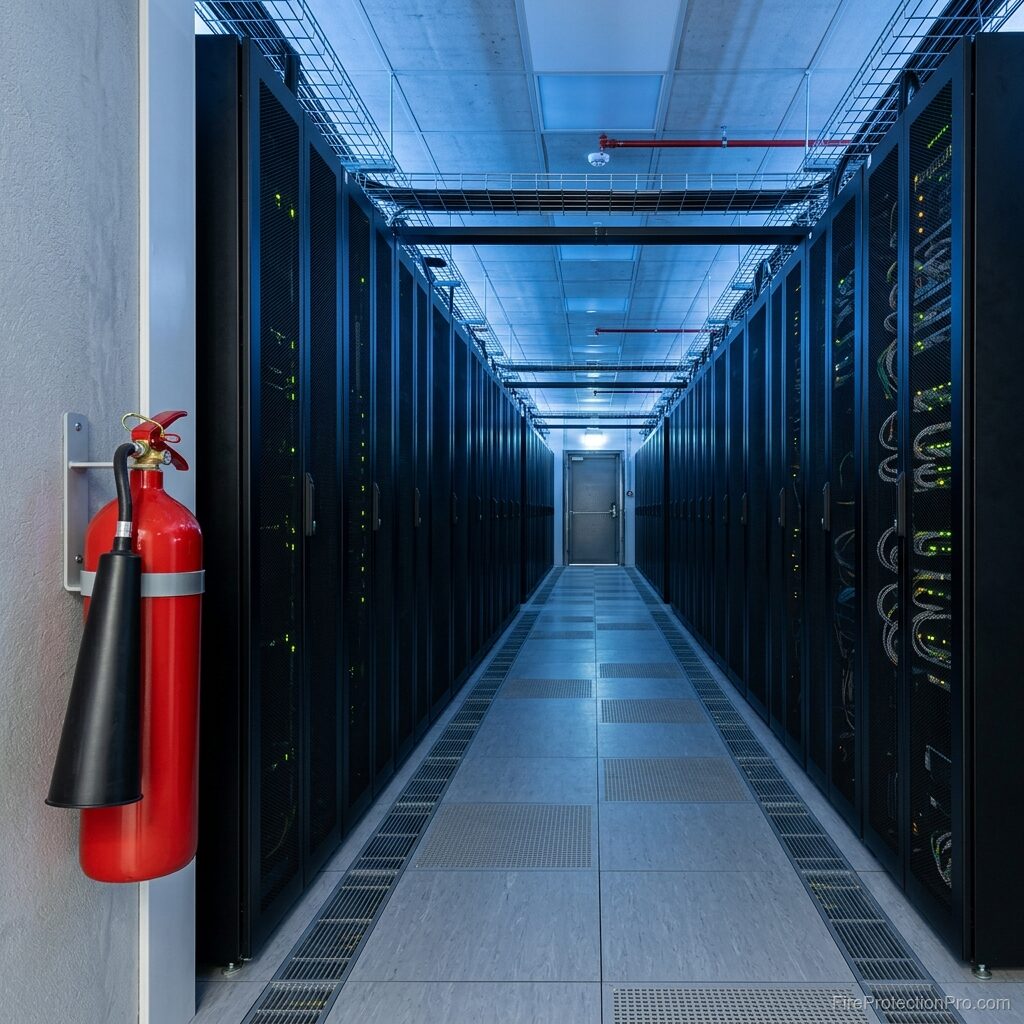
The important detail about Class C is that it rarely exists alone. Once power is removed from the equipment, the remaining fire is usually Class A (the plastics, cabling insulation, and cardboard packaging that surround the racks). That is why extinguishing agents are not rated "Class C" on their own merit. A Class C fire extinguisher carries that rating because its agent is electrically non-conductive and therefore safe to use on energized equipment. The agent still has to handle the underlying Class A or Class B fuel once the power is off.
Why Ordinary Extinguishers Are the Wrong Choice
The two most common commercial extinguishers, water and ABC dry chemical, are both poor matches for a room full of electronics.
- Water and foam conduct electricity. Using a water-based unit on energized equipment creates a shock hazard for the operator and can spread the fault. Water is a Class A and Class B agent, never Class C.
- ABC dry chemical leaves a destructive residue. Monoammonium phosphate powder is mildly corrosive and electrically conductive once it absorbs humidity. A single discharge coats every exposed board, connector, and fan in the room. Equipment that survived the fire often fails afterward from the cleanup agent, and the powder is extremely difficult to remove from racks and raised-floor plenums.
For a server room you want a "clean" agent: one that extinguishes the fire and then disappears, leaving nothing to wipe down and nothing to conduct current. Two portable options meet that standard.
CO2 Extinguishers
Carbon dioxide units discharge a cloud of cold CO2 gas that smothers the fire by displacing oxygen and provides a small amount of cooling. They leave no residue and are electrically non-conductive, which makes CO2 fire extinguishers a long-standing choice for electrical panels, server racks, and other energized equipment. They carry a Class B and Class C rating and are inexpensive to own and recharge.
The trade-offs to plan around:
- Short range and discharge. The effective reach is only about 3 to 8 feet, and the gas dissipates quickly. You have to be close to the fire, and CO2 is weak on deep-seated fires that can reignite once the gas clears.
- Oxygen displacement in small rooms. In a tight, enclosed closet the same oxygen displacement that smothers the fire is a hazard to the operator. Ventilate and evacuate after use.
- Cold discharge. The horn and gas are extremely cold, which can thermally shock sensitive components and is uncomfortable to handle bare-handed.
CO2 is the practical, budget-friendly pick for electrical panels, smaller IT closets, and spot coverage of individual racks.
Halotron and Clean-Agent Extinguishers
Halotron is a halogenated clean agent developed to replace the Halon 1211 units that were phased out under the Montreal Protocol. Halotron clean-agent extinguishers discharge a rapidly evaporating liquid that turns to gas on contact, leaving no residue and conducting no electricity. They behave more like a true firefighting stream than CO2, with greater range, a longer discharge time, and stronger knockdown on the underlying fire.
Where Halotron earns its higher price:
- Better reach and control. Longer effective range and discharge time make it easier to reach a fire deeper in an aisle or rack than a short-range CO2 unit.
- Broader class coverage. Smaller Halotron units are rated Class B and C; larger units add a Class A rating, so a single extinguisher can cover both the energized equipment and the ordinary combustibles around it.
- Gentler on the room. It does not produce the severe cold discharge or the same confined-space oxygen displacement concern as CO2, which matters in a small occupied server closet.
Clean agents are the choice for high-value data center floors, telecom rooms, labs, and clean rooms where maximum equipment protection and broader coverage justify the cost.
CO2 vs Halotron: Quick Comparison
- Residue: none for either; both are safe on electronics.
- Conductivity: both non-conductive and Class C rated.
- Range and discharge: CO2 is short range and short duration; Halotron reaches farther and discharges longer.
- Class ratings: CO2 is Class B and C only; Halotron is B and C in small sizes, A, B, and C in larger sizes.
- Confined-space risk: CO2 displaces oxygen more aggressively; Halotron is gentler in small occupied rooms.
- Cost: CO2 is cheaper to buy and recharge; Halotron costs more.
- Best for: CO2 for electrical panels and smaller closets on a budget; Halotron for data center floors, telecom, and labs where coverage and equipment value are highest.
Sizing, Placement, and Quantity
Under NFPA 10, the size and number of extinguishers depend on the hazard and on travel distance, not on a single fixed rule. For a server room, plan around these points:
- Travel distance. An extinguisher must be reachable within the maximum travel distance for the surrounding hazard (commonly up to 75 feet for Class A and 50 feet for Class B). In practice that means a unit at the room entrance and additional units for larger floors.
- Typical sizing. A 5 or 10 pound CO2 unit covers electrical panels and smaller closets well. An 11 pound or larger Halotron unit is common for data center floors where reach and Class A coverage matter.
- Mount and mark. Wall-mount units on a bracket or in a cabinet, keep them visible and unobstructed, and sign the location.
Remember that portable extinguishers supplement, but do not replace, engineered suppression. A real data center is usually protected by a fixed clean-agent total-flooding system (governed by NFPA 2001) or a pre-action sprinkler system, with the broader IT-room fire protection scope set by NFPA 75 (Standard for the Fire Protection of Information Technology Equipment). Portable units handle a small, early-stage fire that a person can safely approach. For the firestop and raised-floor side of data center compliance, see our firestop sealant requirements guide.
Don't Forget the Rest of the Room
The racks are Class C, but the room around them is full of Class A combustibles: cardboard, packaging, paper, and plastics. A facility has two reasonable approaches. Use CO2 near the energized equipment plus a separate Class A unit for general combustibles, or use a larger A, B, and C rated Halotron unit that covers both with one residue-free extinguisher. The second option is simpler to train staff on and avoids someone grabbing the wrong unit under pressure.
Inspection and Maintenance
Whichever agent you choose, the unit only helps if it works when someone reaches for it. CO2 and clean-agent extinguishers follow the same NFPA 10 inspection lifecycle as any commercial unit: monthly visual checks, annual professional inspection, and periodic hydrostatic testing. CO2 units in particular must be weighed annually and recharged if they have lost more than 10 percent of their net weight, and they require hydrostatic testing every five years rather than the 12-year cycle for dry chemical. The full schedule is in our commercial fire extinguisher inspection guide.
When to Call a Licensed Contractor
A qualified contractor can assess your specific room, confirm the right agent and sizing for your equipment and layout, and coordinate portable extinguishers with any fixed suppression system. Call a professional when you are building or upgrading a server room, when you are unsure whether your current units are the correct type for energized equipment, or when annual inspection and hydrostatic test dates are approaching.
For commercial fire protection services in Texas, including extinguisher selection, inspection, and suppression system support, find a licensed professional near you. We connect commercial property owners with contractors who handle inspection, testing, and compliance documentation.
Continue reading
- Commercial Fire Extinguisher Inspection Requirements
- Firestop Sealant Requirements for Commercial Buildings
- Kitchen Hood Suppression Systems: A Guide for Commercial Properties
Service pages