Fire-rated walls and floors are only as good as their weakest point. Every pipe, conduit, cable tray, and HVAC duct that passes through a rated assembly creates a penetration that compromises the fire rating unless it is properly sealed. That seal is a firestop. Without it, fire, smoke, and toxic gases can spread through the building in minutes, bypassing the compartmentation the rated assembly was designed to provide.
The International Building Code (IBC) Section 714 requires firestopping at all penetrations through fire-resistance-rated assemblies. This is not optional, not a best practice, and not something that can be deferred. Every through-penetration in a rated wall or floor must be sealed with a listed firestop system that has been tested to restore the assembly's original fire rating.
How Intumescence Works
Most modern firestop products rely on intumescence: a chemical reaction where a material swells dramatically when exposed to heat. Understanding this mechanism explains why firestop products work and why ordinary sealants do not.
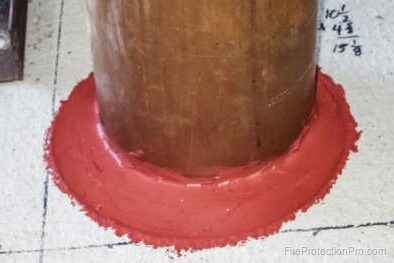
Intumescent materials contain reactive compounds (typically sodium silicate, graphite, or hydrated minerals) embedded in a binder. At ambient temperatures, the material is stable and behaves like a conventional sealant or coating. When temperatures reach approximately 250 to 400 degrees F (depending on the formulation), the reactive compounds decompose and release gas. The gas inflates the softened binder into a rigid, insulating char that can expand to several times the original volume of the material. This expanded char fills gaps, seals around penetrating items, and insulates the unexposed side of the assembly from heat transfer.
The expansion is not random. It is engineered to occur at temperatures consistent with the early stages of a fire, before the fire-rated assembly itself begins to fail. The char that forms is rigid enough to resist the pressure of fire gases pushing through the penetration, and it has low thermal conductivity, which slows heat transfer to the unexposed side.
This is why standard silicone, latex, or polyurethane sealants cannot substitute for firestop products. Conventional sealants soften, burn, or melt away at fire temperatures, leaving the penetration wide open. They have no intumescent chemistry and produce no insulating char. A penetration sealed with regular caulk will behave as an unprotected opening during a fire.
Types of Firestop Products
Firestopping is not a single product. It is a category of products, each designed for specific penetration types, substrates, and service conditions. Using the wrong product for the application is one of the most common firestop failures.
Intumescent Caulk (Firestop Sealant)
Intumescent caulk is the most widely used firestop product for small to medium penetrations. It looks similar to standard construction caulk but contains compounds that expand significantly when exposed to heat, typically expanding 3x to 5x their original volume. This expansion seals gaps that open up as building materials and penetrating items deform or melt during a fire. For a deeper look at sealant types, classifications, and how intumescent products compare to standard construction sealants, see this sealant and caulking guide.
Intumescent caulk works well for cable and conduit penetrations, small pipe penetrations (both metallic and plastic), and irregular gaps around mechanical services. It is applied with a standard caulk gun and is easy to inspect visually.
Firestop Collars and Wraps
Firestop collars are metal housings lined with intumescent material that wrap around plastic pipes (PVC, CPVC, ABS) where they pass through rated assemblies. When a fire melts the plastic pipe, the intumescent lining expands inward to seal the opening left behind. Collars are required because plastic pipe penetrations cannot be sealed with caulk alone. The pipe will melt away, leaving an open hole that caulk cannot close.
Wrap strips serve a similar function and are used where collars cannot be installed due to space constraints. The strip wraps directly around the pipe and is held in place with wire or a metal band.
Firestop Pillows and Bags
Firestop pillows are fabric bags filled with intumescent material, designed for large openings like cable tray penetrations, bus duct openings, and mechanical chases. They are removable and re-stackable, which makes them practical for penetrations where cables are added or removed frequently. The pillows expand when exposed to heat to fill the opening.
Pillows are not a permanent seal in the same way caulk or collars are. They are appropriate for dynamic penetrations where the configuration changes over time, but they must be restacked and the opening re-inspected after any cable additions or removals.
Putty Pads
Putty pads are sheets of intumescent material applied to the backs of electrical outlet boxes and switch boxes installed in fire-rated walls. Standard electrical boxes create unsealed openings in the wall cavity that allow fire and smoke to pass between compartments. The putty pad wraps around the back and sides of the box, expanding in heat to seal the opening.
Putty pads are commonly missed during construction because they are installed by the electrical contractor, not the firestop contractor, and inspectors may not check for them unless the jurisdiction specifically requires documentation.
Where Firestopping Is Required
IBC Section 714 defines three categories of conditions that require firestopping. Each has specific requirements, and the hourly fire rating of the firestop system must match or exceed the rating of the assembly it protects.
Through-Penetrations (Section 714.4)
Any item that passes entirely through a fire-resistance-rated assembly, from one side to the other, is a through-penetration. This includes pipes, conduits, cables, ducts, and any other building service that crosses a rated wall or floor. The firestop system must be tested and listed for the specific penetrating item type, size, and annular space in the assembly type (concrete, gypsum, CMU, etc.).
Construction Joints (Section 714.5)
Joints between fire-rated assemblies, such as the joint between a fire-rated wall and a fire-rated floor slab, or between two sections of fire-rated wall, require a listed joint system. These joints can open and close with building movement, so the firestop system must accommodate that movement while maintaining its rating. Standard sealants without fire testing do not qualify.
Perimeter Joints (Section 714.6)
The gap between a floor slab and an exterior curtain wall (the "perimeter fire barrier system" or edge-of-slab condition) must be sealed with a listed perimeter joint system. This gap exists in virtually every curtain wall building and is a primary path for vertical fire spread between floors. Perimeter firestop systems typically use mineral wool safing insulation backed by intumescent sealant.
Rating Requirements
The firestop system's tested fire rating must equal or exceed the required rating of the assembly it protects. A 2-hour rated wall requires a firestop system tested to 2 hours. A 1-hour rated floor requires a 1-hour firestop system. There is no allowance for using a lower-rated firestop in a higher-rated assembly.
Testing Standards
Firestop systems are tested to specific standards that define the fire exposure, acceptance criteria, and rating classifications. Understanding these standards matters because inspectors and specification writers reference them by number, and the tested configuration (the "system number") is the basis for every firestop installation.
UL 1479 (ASTM E814): Through-Penetrations
UL 1479 is the primary test standard for firestop systems installed in through-penetrations. The test exposes the firestop system to a standard fire curve (ASTM E119) and measures three performance characteristics, each with its own rating:
- F-rating (Flame): The time in hours that the firestop system prevents the passage of flame through the penetration. Every firestop system receives an F-rating.
- T-rating (Temperature): The time in hours until the unexposed side of the penetration reaches 325 degrees F above ambient. The T-rating measures heat transfer through or around the penetrating item. T-ratings are typically required for floor penetrations and wall penetrations in certain occupancy types. A system can have a 2-hour F-rating but only a 1-hour T-rating if the penetrating item conducts heat to the unexposed side before 2 hours.
- L-rating (Leakage): The volume of air leakage through the firestop system, measured in cubic feet per minute per square foot of opening. L-ratings address smoke migration and are specified in smoke barrier and smoke partition applications.
UL 2079 (ASTM E1966): Joint Systems
UL 2079 tests firestop systems installed in construction joints (wall-to-wall, wall-to-floor, floor-to-floor). Joint systems must accommodate movement, so the test includes cycling the joint to its rated movement capability before the fire test. Joint systems receive F-ratings and, where required, T-ratings.
ASTM C920 and Sealant Classification
While ASTM C920 is not a fire test standard, it governs the base sealant classification for elastomeric joint sealants used in construction. Many firestop sealant products are formulated to meet both ASTM C920 for adhesion, movement capability, and durability, as well as UL 1479 or UL 2079 for fire performance. Understanding ASTM C920 sealant classifications helps when evaluating whether a firestop product also meets the non-fire performance requirements for the joint or penetration.
Common Firestopping Mistakes
Most firestop failures are not caused by product defects. They are caused by incorrect product selection, improper installation, or failure to match the tested UL system configuration.
- Using non-rated sealant. Standard silicone or latex caulk is not firestop caulk. It will not expand, will not maintain a seal under fire conditions, and does not carry a UL listing. Using regular caulk in a fire-rated penetration voids the rating and creates an unprotected opening.
- Not matching the UL system number. Every firestop installation must correspond to a specific UL system number that defines the assembly type, penetrating item, annular space, sealant depth, and backing material. Substituting materials, changing dimensions, or skipping components invalidates the system. "Close enough" does not apply.
- Oversized annular spaces without backing. When the gap around a penetrating item is too large for sealant alone, the tested system typically requires a backing material (mineral wool, ceramic fiber) installed to a specified depth before the sealant is applied. Filling a large gap with sealant only, without the tested backing, is not compliant even if the sealant itself is listed.
- Missing firestop at concealed spaces. Penetrations above drop ceilings, inside mechanical chases, and behind walls are frequently missed because they are not visible during routine walkthroughs. These concealed penetrations still require firestopping.
- Firestopping plastic pipe with caulk only. Plastic pipe (PVC, CPVC) melts in a fire, leaving an open hole. Caulk applied around the outside of a plastic pipe will not close the opening when the pipe is gone. Plastic pipe penetrations require intumescent collars, wraps, or a tested system specifically designed for combustible penetrants.
- Disturbing existing firestop without re-sealing. Adding a cable to an existing sealed penetration or removing a pipe from a firestopped opening requires the firestop to be restored. Partial removal or patching with untested materials is not compliant.
Inspection and Documentation
Firestop installations are subject to inspection by the authority having jurisdiction (AHJ), typically the local building inspector or fire marshal. The level of documentation and third-party oversight varies by jurisdiction and project type, but the trend is toward more rigorous documentation, not less.
AHJ Inspection Requirements
Most jurisdictions require firestop installations to be inspected before they are concealed by finish materials (drywall, ceiling tiles, etc.). The inspector verifies that the installed system matches the listed UL system number, that materials and dimensions are correct, and that the installation appears consistent with the manufacturer's installation instructions.
Some AHJs accept visual inspection only. Others require the contractor to submit a firestop log or tracking document that lists every penetration, its location, the UL system number used, and the date of installation. This documentation becomes part of the permanent building record.
Firestop Log and Tracking Systems
A firestop log is a record of every firestopped penetration in the building. Each entry typically includes the penetration location (floor, room, wall ID), the penetrating item type and size, the UL system number, the firestop product used, the installer, and the date. Photographs of each installation before concealment are standard practice on larger projects.
Some owners and general contractors use digital tracking systems that tag each penetration with a unique ID and link it to photos and system documentation. This level of tracking is not universally required, but it simplifies future inspections and tenant improvement work where existing firestops may need to be modified.
Third-Party Inspection Programs
On critical facilities (hospitals, data centers, high-rise buildings), third-party firestop inspection may be required by code, by the owner, or by the insurance carrier. FM Global (formerly Factory Mutual) and UL both offer inspection and certification programs for firestop installations. These programs involve independent inspectors who verify installations against the listed systems and provide a report or certificate.
Insurance carriers that write large commercial policies increasingly require documented firestop inspections as a condition of coverage. If your carrier asks about firestopping during an underwriting review, having a firestop log and third-party inspection report available is the fastest way to resolve the question.
Frequently Asked Questions
Can I use regular silicone caulk as firestop?
No. Standard silicone, latex, or polyurethane caulk is not a firestop product. These sealants will burn, melt, or fall out of the joint during a fire, leaving the penetration completely unprotected. Firestop sealants are specifically formulated to expand (intumescent products) or maintain their integrity under fire conditions, and they carry a UL listing with tested system numbers that define exactly how they can be used. There is no substitution. If the product does not carry a UL 1479 or UL 2079 listing, it is not a firestop.
What is the difference between F-rating and T-rating?
The F-rating (flame) measures how long a firestop system prevents flame and hot gases from passing through the penetration. The T-rating (temperature) measures how long until the unexposed side of the penetration gets hot enough to ignite nearby combustibles (325 degrees F above ambient). A firestop system always has an F-rating. It may or may not have a T-rating, and the T-rating is often shorter than the F-rating because heat conducts through metallic penetrating items (steel pipes, conduit) faster than flame passes through the seal. T-ratings are typically required for floor penetrations, where combustible materials on the floor above could ignite from conducted heat.
How often does firestopping need to be inspected?
There is no universal inspection interval for firestopping after initial installation. IBC requires firestop systems to be inspected before concealment during construction. After that, ongoing inspection depends on the jurisdiction, the occupancy type, and the owner's maintenance program. Some jurisdictions require periodic inspection of fire-rated assemblies (including firestopping) as part of the fire code maintenance requirements. NFPA 1, the Fire Code, and NFPA 101, the Life Safety Code, both address maintenance of fire-resistance-rated construction. Best practice is to inspect firestopping whenever tenant improvement work is done, when penetrations are added or modified, and during periodic fire protection system inspections.
What happens if firestopping is missing during a fire inspection?
The fire marshal or building inspector can issue a correction notice requiring the owner to install compliant firestopping within a specified timeframe. If the deficiency is severe (large unprotected openings in rated assemblies), the AHJ can restrict occupancy or require a fire watch until corrections are made. Missing firestopping also creates insurance exposure: a fire loss involving unsealed penetrations in rated assemblies gives the carrier grounds to contest coverage. The owner is responsible for maintaining fire-rated construction, including firestopping, regardless of whether the deficiency was caused by the original contractor, a tenant improvement project, or subsequent building maintenance.
When to Call a Licensed Contractor
- New construction or tenant improvement projects with penetrations through fire-rated assemblies.
- The AHJ has flagged missing or non-compliant firestopping during an inspection.
- Cables, pipes, or conduits have been added to existing penetrations without re-sealing.
- A fire or water event has damaged existing firestop installations.
- You are preparing for an insurance inspection or FM Global review and need documentation.
- You are unsure whether existing sealant in rated penetrations is actually a listed firestop product.
Firestopping requires knowledge of tested UL systems, correct product selection, and proper installation technique. General caulking contractors are not qualified. Use a contractor experienced in firestop installation who can provide documentation of the systems installed.
For firestopping and fire protection services in Texas, find a licensed contractor near you.
Standards and Code References
The following standards and codes govern firestopping in commercial buildings:
- IBC Section 714: Penetrations and joints in fire-resistance-rated assemblies. Defines requirements for through-penetrations, construction joints, and perimeter joints.
- UL 1479 (ASTM E814): Fire test standard for through-penetration firestop systems. Defines F-rating, T-rating, and L-rating criteria.
- UL 2079 (ASTM E1966): Fire test standard for joint firestop systems, including movement testing.
- ASTM C920: Standard specification for elastomeric joint sealants, covering classification, adhesion, and movement capability.
- Fire suppression and protection standards: Additional code references for fire protection systems in commercial buildings.
Continue reading
- Commercial Sprinkler Inspection Checklist
- Commercial Fire Alarm Monitoring Guide
- NFPA 13 vs NFPA 25: What Commercial Owners Need to Know
Service pages